AI agents that keep telco service moving across systems, channels, and volume spikes
Rasa helps telecommunications providers automate the workflows that define customer service, from plan changes and onboarding to troubleshooting, billing, and retention. AI agents operate across existing BSS, CRM, provisioning, voice, and digital systems to deliver faster resolution, more consistent experiences, and stronger operational control at scale.
Organizations including Deutsche Telekom, Swisscom, Orange, and T-Mobile use Rasa to handle millions of conversations, modernize voice and chat support, and automate high-volume service moments without losing control over how workflows behave.




How it works
Connect to Teleco Systems
Work across customer, billing, provisioning, and support systems so AI agents can act on real subscriber requests instead of just answering them.


Build Workflows That Actually Execute
Guide subscribers through plan management, troubleshooting, onboarding, billing, and retention moments using AI agents aligned to your policies, systems, and service logic.
Reuse What Works and Expand Faster
Build modular workflows that can be orchestrated across voice, chat, IVR, and digital channels, helping teams launch new service experiences faster while keeping operations consistent.

Built for high-value, high-stakes conversations
Subscriber account management
Troubleshooting & Outage Handling
Billing Support & Dispute Resolution
Onboarding and Service Activation
Retention & Winback
Offer Guidance and Plan Expansion
AI agents that can handle real subscriber work
Rasa supports AI agents that do more than respond. They help subscribers complete the next step across account management, troubleshooting, billing, onboarding, and retention workflows.
- Guide subscribers through high-friction service moments
- Keep the interaction moving even when requests shift mid-conversation
- Support the service workflows that matter most to containment and resolution
- Make automation useful in the moments customers actually call about

Built for the telco stack
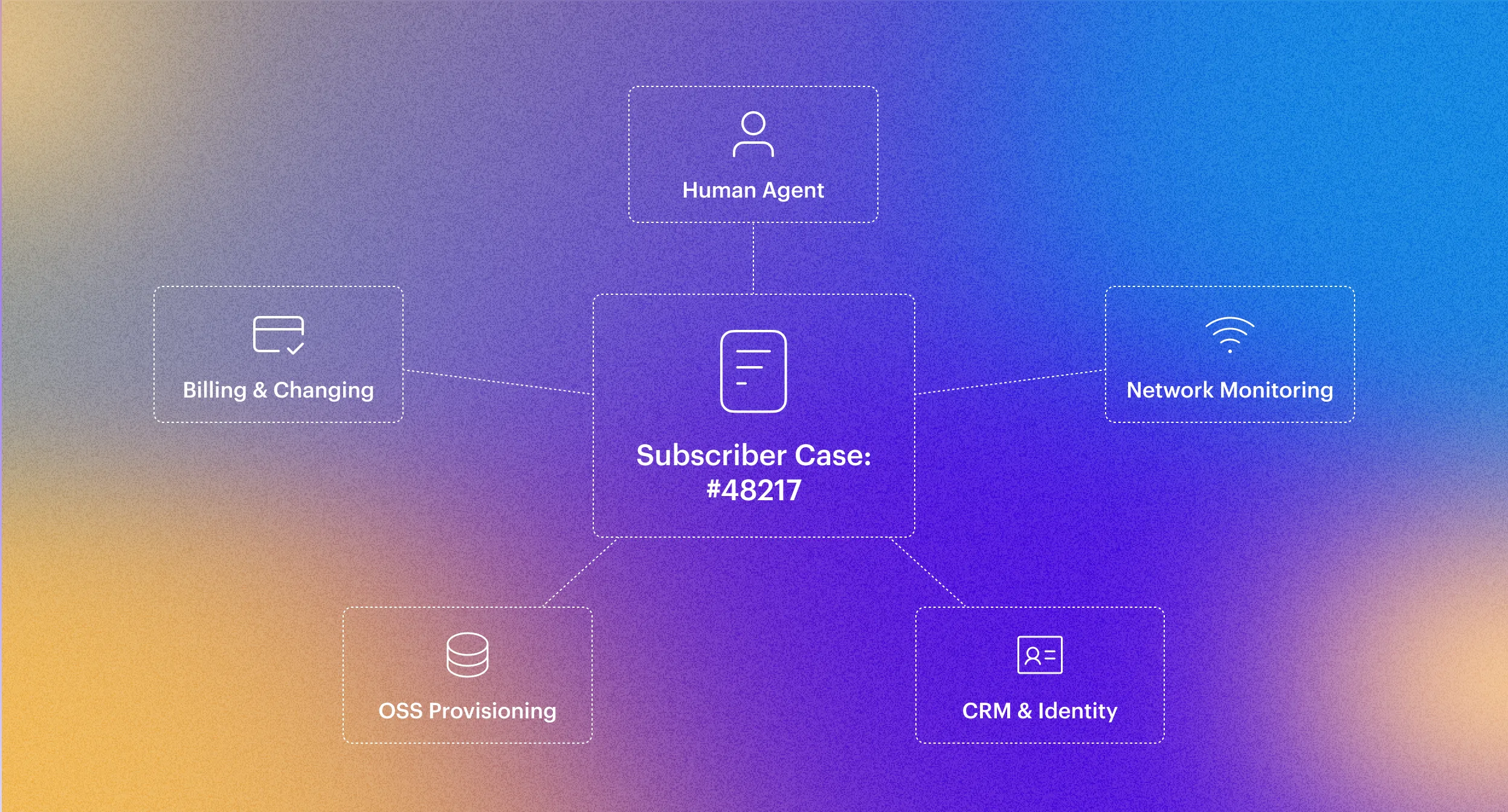
Rasa works with the systems behind service delivery, from billing and provisioning to CRM, IVR, and identity infrastructure.
- Connect to existing telco systems without forcing replatforming
- Support regional, operational, and infrastructure complexity
- Operate within the environments providers already run
- Give teams more flexibility than closed platform models
One reusable service layer across channels
Rasa helps providers turn repeatable workflows into reusable capabilities that can be orchestrated across voice and digital support.
- Reuse workflows across voice, chat, IVR, apps, and messaging
- Extend the same logic across plan management, support, onboarding, and billing
- Reduce duplication across teams, channels, and markets
- Scale customer service without multiplying complexity


Ownership and extensibility from day one
Rasa gives telecom teams control over how service workflows behave, how systems connect, and how the platform evolves over time.
- Modify workflows, prompts, and integrations directly
- Adapt quickly to new offers, policies, and service models
- Extend the platform without vendor dependency
- Build on a system your team can operate long term


Our goal was to align cutting-edge AI technology with customer needs to provide seamless and innovative experiences. Partnering with Rasa allowed us to rethink how conversational AI could transform support.

We developed a real partnership with Rasa based on developing skills rapidly, correcting bugs quickly, and sharing a wish list with the dev team.
Resources

Swisscom: From 6 Years to 2 Sprints
How Swisscom rebuilt its customer assistant with Rasa — achieving 3x automation rate, 2.5x NPS improvement, and a production-grade voice IVR system.

How Deutsche Telekom Automates Customer Service
How Deutsche Telekom built a centralized multilingual AI assistant that handles millions of interactions across mobile, broadband, and TV support.
How Swisscom Built Multilingual AI Agents at Scale
Swisscom, a leader in Swiss telecommunications, wanted to revolutionize its digital customer service with smarter, faster, and more scalable solutions.
See How Rasa Works for Telecommunications
See how telecommunications providers use Rasa to reduce service pressure, improve containment, and deliver more consistent support across voice, chat, and IVR.

Frequently asked questions
What telecommunications workflows can Rasa automate?
Rasa can automate workflows such as SIM activation, plan changes, troubleshooting, outage support, billing inquiries, onboarding, retention, and escalation support across voice and digital channels.
Can Rasa deploy on-premises to meet our data residency requirements?
Yes. Rasa is designed for regulated industries where data residency and infrastructure control are non-negotiable. You can deploy fully on-premises, in a private cloud, or in a hybrid configuration. Rasa does not require sending data to external cloud environments, and your LLM selection and model routing stay within your own infrastructure.
Can Rasa support both voice and digital telco experiences?
Yes. Rasa enables one coordinated system across voice, chat, IVR, apps, and messaging, helping providers deliver more continuous subscriber experiences across channels.
What happens when a customer's conversation crosses multiple topics or channels?
Rasa maintains context across the interaction so subscribers can switch topics, move between channels, or resume after interruptions without starting over. This is especially important in telecom, where one conversation often spans account questions, technical support, and billing in the same session.
Does Rasa integrate with existing BSS, CRM, and provisioning systems?
Yes. Rasa connects to existing telco back-end systems via APIs, webhooks, and custom Python actions — without requiring migration or middleware abstraction. Telcos typically integrate CRM, BSS, billing engines, provisioning systems, and identity platforms. Deutsche Telekom and Swisscom both run Rasa integrated with their production infrastructure, handling millions of transactions at scale.
How does Rasa support compliance and auditability for regulated telco markets?
Rasa helps providers keep service automation transparent and reviewable. Teams can inspect how a workflow ran, what context was used, and why an escalation or action happened. This supports consent tracking, dispute handling, operational review, and other requirements in regulated telecom environments.
Can Rasa handle multilingual support across regions andmarkets?
Yes. Rasa supports reusable workflows across languages and regions, helping providers deliver more consistent subscriber experiences without duplicating core service logic in every market. Swisscom's assistant runs in German, French, Italian, and English from a shared logic foundation. Deutsche Telekom uses Rasa across multiple European markets.
How quickly can a telecom company deploy Rasa in production?
Rasa is designed for rapid iteration. T-Mobile built and launched its first production agent in two months. Swisscom rebuilt its assistant and achieved production-grade results within two sprints. Rasa's open framework, versioned flows, and CI/CD support allow teams to ship updates two to three times per week after initial deployment.
Related Industries
Rasa powers AI agents for account servicing, loan origination, and compliance-driven customer support at regulated banks and fintechs.→
From appointment scheduling to clinical triage, Rasa enables HIPAA-compliant conversational agents that connect to EHR systems and care workflows. →
Automate policy inquiries, claims intake, and renewal conversations with structured flows that enforce underwriting rules and document every decision. →
Rasa agents handle order management, product discovery, and loyalty interactions at scale — across web, app, and messaging channels. →
AI that adapts to your business, not the other way around
Build AI agents your telecom team can control and scale
The control of building in-house. The speed of buying off-the-shelf. The governance required to operate at enterprise scale.